Caveat Co-Op · Free · Kindergarten to grade 8
Is my child
on grade level?
A plain guide to what "on grade level" means and how to find out, and short checks in reading and math you can do together at home. The result is a list of skills, not a label, and a next step that fits.

What "on grade level" means
And why the answer is often less clear than a report card makes it look.
Each grade has standards: the skills students are expected to learn by the end of that year. "On grade level" usually means a child has the skills expected for the grade at that point in the year.
Families often hear "doing fine" while a child is quietly missing an earlier skill. In a 2023 Gallup and Learning Heroes survey, close to nine in ten parents said their child was at or above grade level in reading and in math, at a time when schools were reporting that about half of their students needed to catch up in at least one subject. Report card grades often reflect effort, homework and behavior as well as skills, so they can look fine even when a skill is missing.
The most useful question is not "Is my child behind?" but "Which skills are solid, and which one should we work on next?"
Where to look
- School screening and benchmark tests (MAP Growth, i-Ready, STAR, Acadience, DIBELS and others). Ask for the reports; the Score Report Explainer explains the numbers.
- State test results, read together with the score range and growth, not just the level.
- Work samples: writing, math homework, a book your child chooses to read. Look at what they can do on their own.
- How long homework takes and how it feels. Thirty minutes of struggle on ten minutes of work is worth noticing.
- The teacher's view, skill by skill. Ask which skills are solid and which need work.
- A quick check at home, like the ones below, to see a few skills for yourself.
How to give the quick check
- Pick a calm time. Ten to fifteen minutes, sitting together, no rush.
- Choose the grade your child is in now. Early in the year, the grade they just finished can be a fairer check.
- Let your child do the work. Do not hint or teach during the check; you can practice afterward. "Not learned yet" is a fine answer.
- Stop if your child gets upset, and try again another day.
- Read the results as a list of skills to keep or to practice. Nothing here is a grade, a score or a diagnosis.
What it can and cannot tell you
The checks sample a few important skills for each grade, chosen from the standards most states teach. A few items cannot cover a whole year, and one sitting can be thrown off by a bad day, nerves or a new kind of question.
It can point you to a skill worth practicing and help you ask better questions at school. It cannot tell you whether your child has a learning disability, and it does not replace what the school sees every day or an evaluation.
Everything your child answers stays in this browser. The results are saved here so you can look again, and one button deletes them. Nothing is sent to Caveat or anyone else.
Start a quick check
The skills each check samples
With the Common Core State Standards number for each skill, as a reference. Many states use these standards or close versions with their own numbering.
Reading: the skills each grade's check samples
| Grade | Skills and standard |
|---|---|
| Kindergarten | Naming letters RF.K.1d; Letter sounds RF.K.3a; Hearing rhymes RF.K.2a; Blending sounds into a word RF.K.2; Hearing the first sound in a word RF.K.2d; Reading short words like "sat" RF.K.3 |
| Grade 1 | Breaking a word into its sounds RF.1.2d; Reading words with blends and digraphs (sh, ch, th) RF.1.3a; Reading words with a silent e RF.1.3c; Reading common irregular words RF.1.3g; Reading a short passage aloud accurately RF.1.4; Recalling key details RL.1.1 |
| Grade 2 | Reading vowel teams and r-controlled vowels RF.2.3b; Reading two-syllable words RF.2.3c; Reading a passage aloud accurately RF.2.4; Answering questions about a story RL.2.1 |
| Grade 3 | Reading longer words RF.3.3c; Finding the main idea RI.3.2; Finding details and making inferences RI.3.1; Word meaning from context RI.3.4 |
| Grade 4 | Reading longer words RF.4.3a; Understanding and inferring from a story RL.4.1; Word meaning from context L.4.4a |
| Grade 5 | Reading longer words RF.5.3a; Finding the main idea RI.5.2; Details, explanations and inferences RI.5.1; Word meaning from context L.5.4a |
| Grade 6 | Word parts: prefixes, suffixes and roots L.6.4b; Following an argument: claim, evidence, response RI.6.8; Word meaning from context L.6.4a |
| Grade 7 | Word parts: prefixes, suffixes and roots L.7.4b; How a text is organized RI.7.5; Inferences and supporting evidence RI.7.1 |
| Grade 8 | Word parts: prefixes, suffixes and roots L.8.4b; Theme RL.8.2; What actions and dialogue reveal about a character RL.8.3; Word meaning from context L.8.4a |
Math: the skills each grade's check samples
| Grade | Skills and standard |
|---|---|
| Kindergarten | Counting objects K.CC.B.5; Comparing numbers K.CC.C.7; Adding and subtracting within 5 K.OA.A.5; Ten and some more (11 to 19) K.NBT.A.1; Counting on from a number K.CC.A.2 |
| Grade 1 | Adding and subtracting within 20 1.OA.C.6; Tens and ones 1.NBT.B.2; Adding tens within 100 1.NBT.C.4; Word problems within 20 1.OA.A.1; Finding a missing number 1.OA.D.8 |
| Grade 2 | Adding and subtracting within 100 2.NBT.B.5; Hundreds, tens and ones 2.NBT.A.1; Comparing three-digit numbers 2.NBT.A.4; Counting money 2.MD.C.8; Two-step word problems 2.OA.A.1 |
| Grade 3 | Multiplication and division facts 3.OA.C.7; Adding and subtracting within 1,000 3.NBT.A.2; Understanding fractions 3.NF.A.1; Area of a rectangle 3.MD.C.7; Two-step word problems 3.OA.D.8; Rounding 3.NBT.A.1 |
| Grade 4 | Multi-digit multiplication 4.NBT.B.5; Dividing by a one-digit number 4.NBT.B.6; Multi-digit subtraction 4.NBT.B.4; Equivalent and comparing fractions 4.NF.A.1; Adding fractions with like denominators 4.NF.B.3; Decimals and tenths/hundredths 4.NF.C.6 |
| Grade 5 | Adding and subtracting fractions with unlike denominators 5.NF.A.1; Multiplying and dividing with fractions 5.NF.B.4; Operations with decimals 5.NBT.B.7; Volume 5.MD.C.5; Decimal place value 5.NBT.A.3 |
| Grade 6 | Ratios, rates and percents 6.RP.A.3; Dividing fractions 6.NS.A.1; Decimal division 6.NS.B.3; One-step equations 6.EE.B.7; Ordering positive and negative numbers 6.NS.C.7 |
| Grade 7 | Adding and multiplying negative numbers 7.NS.A.1; Two-step equations 7.EE.B.4a; Percent problems 7.RP.A.3; Circumference and area of circles 7.G.B.4; Proportional relationships 7.RP.A.2 |
| Grade 8 | Linear equations with variables on both sides 8.EE.C.7; Slope and rate of change 8.F.B.4; The Pythagorean theorem 8.G.B.7; Exponents and scientific notation 8.EE.A.1; Evaluating a function 8.F.A.1 |
Every item and passage in the checks was written for Caveat. None is taken from a state test, a published screener or a curriculum.
When you want to go further
Free and paid next steps from Caveat.
These quick checks are informal practice items for families, not a standardized test, a screening instrument with norms, an evaluation or a diagnosis. Results describe a few skills on one day. Talk with your child's teacher about any concern, and ask the school about an evaluation if you suspect a disability. Common Core State Standards numbering is shown for reference only; © Copyright 2010 National Governors Association Center for Best Practices and Council of Chief State School Officers.
The other branches
One brand. Seven branches. Every grade, every next step.
 For teachersCaveat Classroom
Resources made to order, free tools, professional development, certification prep.
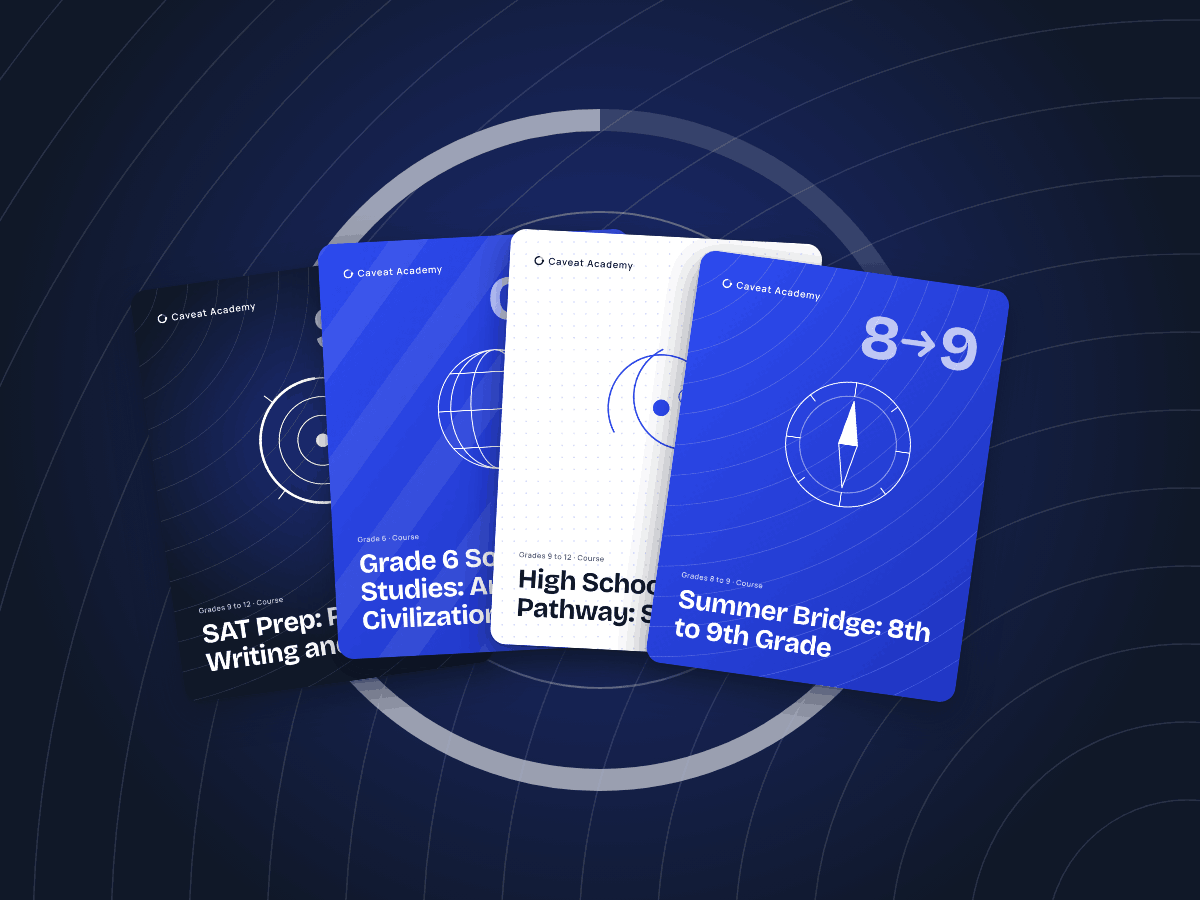 For studentsCaveat Academy
Self-paced courses for grades 6 to 12, from full-year classes to AP and SAT prep.
 For college-bound students and familiesCaveat College
College credit in high school, the college list, applications, paying for college and the move to college.
 For families with questions about learningCaveat Lens
Screeners for grades 1 to 8 that help you decide whether to ask for a full evaluation.
 For social-emotional learningCaveat Cares
Feelings, friendships and self-regulation, for students, families and teachers.
 For career exploration and readinessCaveat Careers
A free Career Explorer, career pathways and electives, and getting ready for a first job.
The Caveat Family Guide to College is general information, not legal, tax or financial advice. Each college decides admission, aid and how credit counts, and requirements change; check each college's own pages. Examples are examples, not promises. Caveat Academic Services is an independent college preparation company. Students do all of their own work.